My physical therapist has a name for the knot that lived under my right shoulder blade for the better part of two years. She calls it “the tenant.” It moved in during a season of back-to-back coaching certifications I completed almost entirely at a laptop, and it refused every eviction notice I served it — massage guns, lacrosse balls, the foam roller I kept wedged beside my desk like a security blanket. So when she watched me lie back on a padded wheel during a session last spring, put my arms overhead, and audibly exhale for the first time in weeks, she just laughed and said, “Well. The tenant finally met its landlord.”
That was my introduction to the back wheel, and I’ve spent the three weeks since running it through the same testing gauntlet my team and I put every recovery tool through before it earns a mention on this site. Here’s what happened — and whether a sixty-dollar wheel deserves a spot in your evening the way it now lives in mine.
The Twenty-Year Grudge in My Trapezius

Let’s start with why desk life does this to us, because understanding the mechanism changed how seriously I took the fix. When you sit and type, your head drifts forward — for every inch it juts past your shoulders, the effective load on your neck roughly doubles. Your thoracic spine, the twelve vertebrae between your neck and lower back, rounds into a slow slouch. Then it stays there for eight or nine hours, five days a week, for years.
The result is what coaches call upper crossed syndrome: tight chest, tight upper traps, sleepy deep neck flexors, and a midback that has forgotten how to extend. I wrote a whole buying guide on posture correctors last summer, and I stand by it — but a brace nudges your shoulders while doing nothing for the stiff, corked thoracic segment that’s driving the whole pattern. The tenant pays rent in your shoulder blade, but the lease is signed in your midback.
Why Your Midback Secretly Runs Your Neck

Here’s the part that surprised me when I first studied exercise physiology: your neck only has so much extension to give. When your thoracic spine locks into flexion, your neck has to make up the deficit every time you look up at a shelf, back out of a driveway, or follow a barbell overhead. Chase mobility in the stiff segment and the overworked segment finally gets a break.
This isn’t just gym-floor folklore. A 2022 randomized controlled trial found that thoracic spine mobility exercises significantly reduced chronic neck pain and disability in office workers — people who, like most of my coaching clients, had been stretching their necks directly for years with almost nothing to show for it. We’ve been pleading with the tenant when we should have been renegotiating with the landlord upstairs.
A Cylinder With a Spine-Shaped Ditch: What a Back Wheel Actually Does
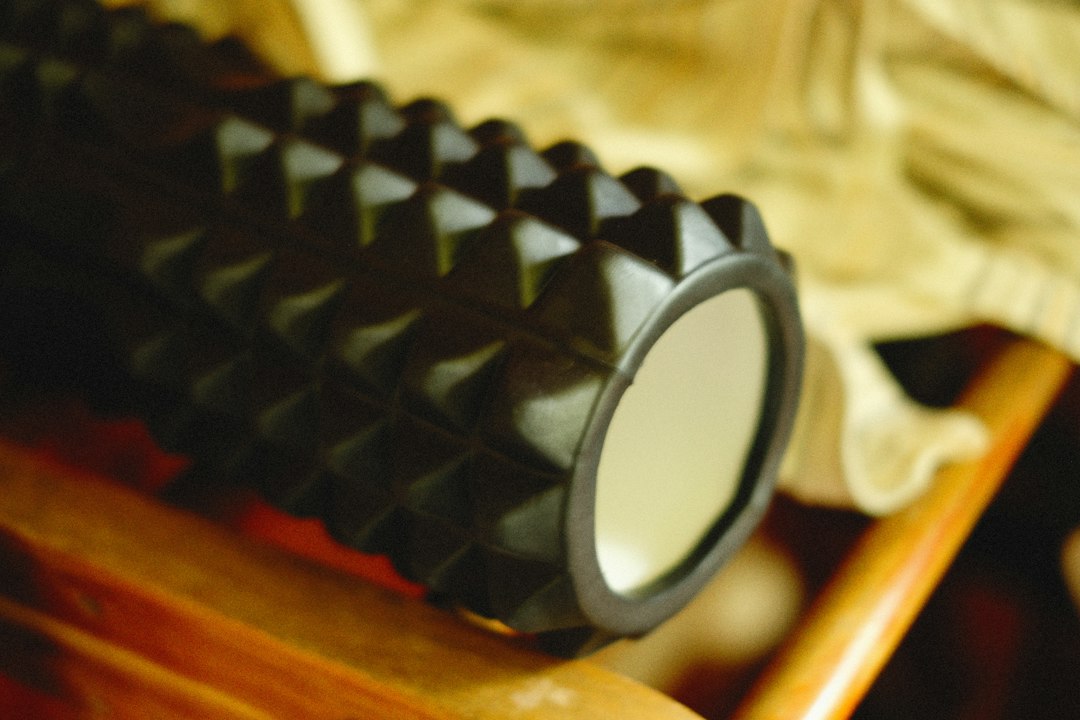
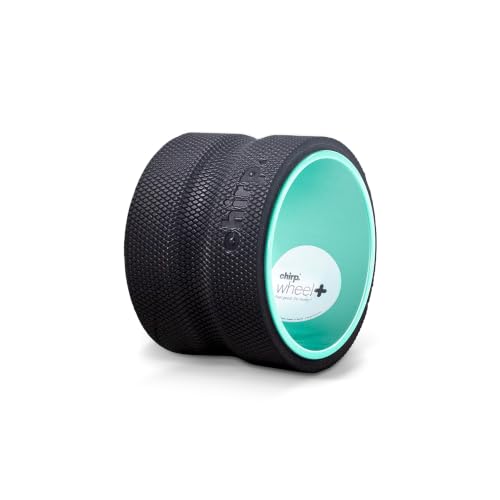
A back wheel looks like someone stretched a foam roller into a donut and gave it a groove down the middle. That groove is the whole point. Your spinous processes — the bony bumps you can feel along your spine — nest into the channel while the curved sides press into the muscles on either side. You get pressure without your spine bearing the brunt of it.
The second difference is subtler: a wheel is round, so lying over its apex creates genuine spinal extension, not just pressure. A foam roller is brilliant for smashing knots, but it’s flat on top — you sink into it. The wheel’s convex arc cradles the mid-thoracic region right where desk hunch peaks, and lets you breathe into a backbend that most of us haven’t accessed since middle school. If you already own a roller, keep it — I still use mine on calves and lats. But for opening a slouched midback, curvature wins, and it’s not close.
Size matters here more than brand. The classic setup is a three-pack — a 12-inch wheel for gentle extension and beginners, a 10-inch for a deeper stretch, and a 6-inch for digging into stubborn muscle. The Chirp Wheel XR 3-Pack is the version with the spinal groove and acupressure-style padding, and it’s the one my physical therapist’s clinic actually stocks. If you’re broader through the shoulders or want more surface contact, the wider XL-format wheel covers more territory per roll. And if you’re curious but budget-cautious, a generic yoga wheel set with the 10mm padding runs meaningfully less — you lose the dedicated spine channel, but the extension benefit survives.
Three Weeks, Three Sizes, One Nightly Ritual
For the experiment, I committed to fifteen minutes a night, every night, for twenty-one days. My team measured my shoulder range of motion with a goniometer before week one and after week three, and I took doorway photos at the same time of day in the same lighting so posture changes couldn’t hide behind flattering angles.
The protocol was simple. I’d start with the 12-inch wheel: sit at its base, lie back slowly, and rock gently side to side for three or four minutes while breathing deep into my ribs. Then the 10-inch for targeted extension — rolling to a stiff segment, pausing, draping my spine over the apex, and holding three slow breaths. I’d finish with the 6-inch on the trapezius and the muscles hugging my shoulder blades, rolling in short strokes like I was kneading dough. The whole sequence closes with thirty seconds of child’s pose, which after week two started feeling like sinking into a warm bath.
Week one was humbling. The first time I lay back on the big wheel, my midback clamped down so hard I laughed out loud at how defended it was. Everything felt stuck, and I needed two pillows behind my head to tolerate the extension. By the second week, the pillows were gone and I could feel my ribs actually moving when I inhaled over the wheel — a sensation I can only describe as my back remembering it has joints. Week three is when the photos got interesting.
What the Tape Measure Said on Day Twenty-One
The numbers first. My shoulder flexion — arms straight overhead — improved from 158 to 172 degrees. My wall angel test, which I use with every client, moved from an embarrassing “elbows keep leaving the wall” to a clean pass. My standing reach behind my back (the scratch test) climbed two finger-widths on the right side, the tenant’s home address.
But the changes I actually noticed were less measurable. I stopped waking up with that concrete feeling across my upper back. Long coaching days stopped ending with my hand absently kneading my shoulder. And twice during week three, my husband caught me rolling my shoulders at dinner and asked what was wrong — the answer was nothing, for the first time in months. For travel days and desk-bound client sessions, I keep a peanut-style double lacrosse ball in my bag as the wheel’s pocket-sized understudy, and the RESTCLOUD cervical relaxer handles the base-of-skull tension that flares after long flights.
The Four-Inch Wheel and the Base of Your Skull

The 3-pack’s smaller sibling deserves its own paragraph because it solved a different problem. The 4-inch neck wheel targets the suboccipital region — the tiny, exhaustingly busy muscles at the base of your skull that clench every time you squint at a screen. Sixty seconds of gentle rolling there, chin slightly tucked, does more for my end-of-day headaches than any amount of shoulder work.
Two cautions, and I mean them. First, never roll your neck side to side on any tool — small, gentle nods only. Second, pressure should feel like a good massage, never sharp or electric. If tingling shoots down an arm, you’re on a nerve, not a muscle; back off immediately. The dedicated 4-inch neck wheel is soft enough for daily use, and if you want to go deeper on stubborn knots between the blades, the firmer 6-inch “knot kneader” version lets you lean your full bodyweight into the search.
Who Should Not Roll (and What I’d Buy Instead)

I love this tool, but I coach enough bodies to know it isn’t for everyone. If you have a known disc herniation, osteoporosis, spinal stenosis, or any neck or back issue currently under a specialist’s care, clear this with that specialist first — extension over a fulcrum is exactly the wrong experiment for some diagnoses. Acute injuries belong with a physical therapist, not a blog post. And if lying back over anything makes you dizzy, skip the position entirely.
For those folks, gentler tools still move the needle. A well-padded acupressure mat gives lying-down relief without spinal extension, and a weighted heated neck wrap handles the muscle-guarding component with zero mechanical demands. I keep both in my recovery closet for the exact days when the wheel isn’t appropriate — including the evenings after my own deep-tissue massages, when everything is too tender to roll.
If you’re building a broader mobility arsenal, my full seven-tool mobility kit breakdown covers where a wheel fits alongside rollers, balls, and bands for under the cost of two PT sessions.
The Fifteen Minutes That Stuck
Twenty-one days ended two weeks ago, and I haven’t stopped. The ritual shrank to fifteen minutes most nights — big wheel, small wheel, child’s pose — parked in front of whatever my family is watching on television. It’s the rare recovery tool that survived the experiment that introduced it, which puts it in the same category as my walking pad during my two-miles-an-hour desk experiment: things that earn permanent shelf space.
The tenant, for the record, still occasionally knocks. But it no longer lives here. If your shoulder blade has been holding a grudge since your last big work season, fifteen minutes on a wheel is the most direct conversation you can have with it — and the single 6-inch wheel is a perfectly good way to start that conversation for about the price of one co-pay. Your midback kept every hour of overtime you ever worked. It’s time to give a few of them back.