
The text came in at 6:40 on a Monday morning, and I could practically hear the wince through the screen: “Slept wrong AGAIN. Can’t turn my head left. Do I skip squats?” It was the third time that month for this particular client, a nurse who sleeps on her side, works twelve-hour shifts, and trains harder than most people half her age. She didn’t need a new program. She needed somebody to look at the thing her head rests on for a third of her life.
So I asked her to send me a photo of her pillow. What arrived was a flattened, decade-old polyester slab folded in half and jammed under her ear like a taco. She’d been folding it for years because it “felt better that way.” Of course it did. Folding it was her body’s way of trying to fill a gap that the pillow had stopped filling a long time ago.
This is the guide I walk clients through when a sore neck keeps showing up in their training log. It isn’t a list of the fanciest pillows on the internet. It’s a fitting process: measure your gap, test it for free with towels you already own, then choose a fill that holds that height all night. My team and I went through the research, compared notes from clients, and boiled it down to what actually moves the needle for side sleepers. Side-sleeper pillow searches have more than doubled this fall, so if you’re one of the people Googling “best pillow for side sleepers with neck pain” at 2 a.m., welcome. Let’s get you fitted.

Why Side Sleepers Get the Short End of the Neck
Lie on your back and your head only has to drop a few inches to meet the pillow. Roll onto your side and everything changes. Now there’s a gap between your ear and the mattress roughly as wide as your shoulder, and something has to fill it. If the pillow is too low, your head tips down toward the mattress and the muscles on the upper side of your neck spend the night on a long, slow stretch. If it’s too high, your head gets cranked toward the ceiling and the other side gets compressed. Either way, you wake up feeling like you lost an argument with a doorframe.
The research backs up what my clients feel every morning. A 2016 biomechanics study that tested four pillow heights found that raising the pillow increased both the pressure on the head and neck and the bend in the cervical spine, which means more is not automatically better. A 2024 study of side sleepers went a step further and showed that the best pillow height depends on your own shoulder width. Pillows that matched each person’s build, especially ones with a little extra support under the neck, kept the spine closest to its natural standing curve and put the least strain on the surrounding muscles.
Here’s the part I love, because it saves people money. An older randomized trial compared regular foam, contour foam, latex, polyester, and feather pillows in side-lying sleepers. Feather was the odd one out, letting the neck sag in ways the others didn’t. But regular foam and contour foam put the spine in basically the same position. The wavy shape isn’t magic. Height and stability are what matter. Shape is a comfort preference.
Pillow height also interacts with your mattress. A soft mattress lets your shoulder sink in, which shrinks the gap, so you need less loft. A firm mattress keeps your shoulder up, which widens the gap, so you need more. That’s why your friend’s “life-changing” pillow felt awful on your bed. You aren’t built the same, and you probably don’t sleep on the same mattress.
The Two-Minute Measurement Nobody Does
Grab a soft tape measure (a Singer Soft Tape Measure costs less than a smoothie) and a friend. Stand normally against a wall with your shoulders relaxed. Have your helper measure straight across from the side of your neck, right under your ear, to the outer edge of your shoulder. That number is roughly the gap a side-sleeper pillow has to fill. Most of my clients land somewhere between four and six inches, and broad-shouldered lifters can come in higher.
Now adjust for your mattress. If you sleep on a plush pillow-top, subtract about an inch, since your shoulder will sink. If your mattress feels firm and your hip barely sinks in, stick with the full number. This won’t be perfect. It’s a starting point, and it beats picking a pillow because the box looked cozy.

Want to know what correct alignment looks like? Lie on your side and have your helper take a photo from behind, at the head of the bed. Your nose, chin, and breastbone should line up roughly parallel to the mattress, and the center of your neck should run in a straight line with the middle of your back. If your head droops toward the mattress, your pillow is too low. If your ear is pushed toward your top shoulder, it’s too high. One photo tells you more than an hour of reading reviews.
The Towel Test: Try Your Height for Free
Before anyone on my roster spends a dollar, I make them build their pillow out of towels for three nights. It’s the same trick physical therapists have used for decades, and it works because towels let you adjust height in small, exact steps.

- Night one: Put your current pillow on the bed and slide a folded bath towel underneath it. Lie on your side and take the alignment photo again. Add or remove folds until your head sits level.
- Night two: Keep that height and add a small rolled hand towel along the bottom edge of the pillow, where it meets your neck. This copies the “neck support” that the 2024 study found worked so well. Some people love it right away. Others find it pokes. Both reactions are useful.
- Night three: Sleep on the setup that felt best and notice how your neck feels at the 6 a.m. alarm, not at bedtime. Morning stiffness is the real test.
Once you have a height that works, measure the whole stack (pillow plus towels, pressed down the way your head presses it). That’s your target loft. Now you’re shopping with a number instead of a feeling.
Three Fills That Actually Hold a Side Sleeper’s Height
The towel stack proves something important: you need a fill that holds its height under the weight of your head from midnight until morning. Fluffy polyester and down feel lovely for the first ten minutes, then flatten into exactly the gap you just measured. These are the three fills I recommend to side sleepers, each for a different kind of person.
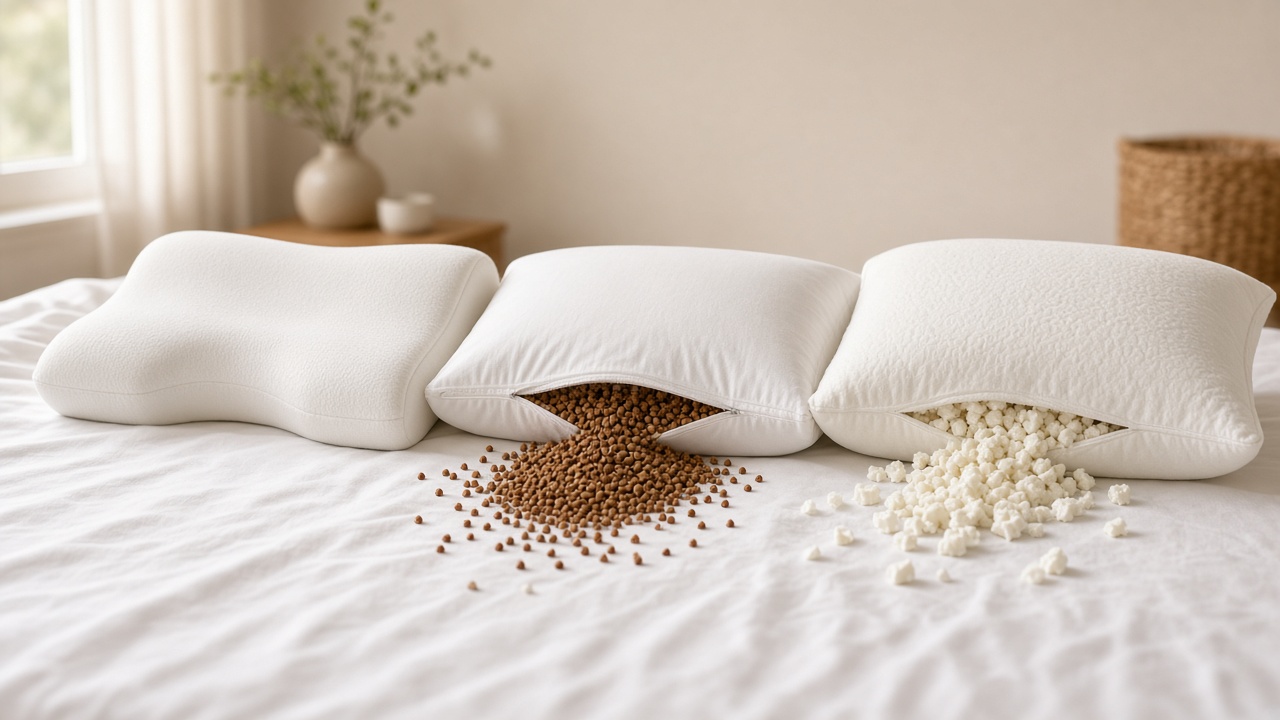
Contour Memory Foam: For the Sleeper Who Wants It Locked In
Solid memory foam is the most predictable option. It’s the same height every night, it doesn’t migrate, and many contour designs build in that raised neck roll that worked in the towel test. The catch is that foam blocks come in fixed sizes, so you need to match your measured loft before you buy. The Tempur-Pedic TEMPUR-Neck Pillow is the dense, firm classic that I point clients with broad shoulders and firm mattresses toward. For a lower price and a softer, cooler feel, the EPABO Contour Memory Foam Pillow comes with an insert you can remove to lower the height, which is a nice safety valve if you land between sizes.
One honest warning: memory foam holds heat. If you already run warm at night (hello, perimenopause), check out the cooling ideas in my hot-flash bedroom kit before you commit to a solid block of foam.
Buckwheat: For the Tinkerer Who Hates Sinking
Buckwheat pillows are filled with the hard outer hulls of buckwheat seeds, and they act completely differently from anything else on this list. Instead of squishing, the hulls shift and lock around the shape of your head and neck, then stay put. You set your height by adding or removing hulls through a zipper, so you can dial in your exact towel-test number. They breathe beautifully, too, because air moves freely between the hulls.

The trade-offs are real, so I always mention them. Buckwheat pillows are heavy, they make a soft crunching sound when you move, and they take about a week to get used to. My nurse client hated hers for four nights and now refuses to travel without it. The Sobakawa Buckwheat Pillow is an affordable way to try one, and the Hullo Buckwheat Pillow is the premium pick with a roomier cover and extra hulls you can add as it settles.
Adjustable Shredded Fill: For Almost Everyone Else
If I had to give one pillow to a side sleeper I had never met, it would be a shredded memory foam pillow with a zipper. You get the support of foam with the adjustability of buckwheat, minus the crunch and the weight. Pull out a handful of fill at a time until the pillow matches your towel stack, and save the extra in a bag so you can add it back later as the fill settles.
The Coop Home Goods Original Adjustable Pillow is the one I see most often on clients’ beds, and it holds its height well once you’ve tuned it. The Xtreme Comforts Shredded Memory Foam Pillow is a budget-friendly alternative that works the same way. Fluff either one every morning, the way you’d shake out a duvet, so the fill doesn’t pack down into one hard corner.
What I Tell Clients to Retire Tonight
Some pillows simply can’t support a side sleeper’s neck, no matter how much you love them. Here’s my short list of what to retire:
- Any pillow you fold in half to make it work. If you fold it, you’ve outgrown it. The fold is a temporary fix that collapses by 3 a.m.
- Flat feather pillows for a sore neck. That trial I mentioned found feather pillows let the neck settle very differently from foam and latex. Feathers are lovely to hug, but they’re not great as your only support.
- Anything that fails the fold test. Fold a fiber pillow in half and let go. If it doesn’t spring back open, it’s done.
- Two old pillows stacked together. Stacking gives you height without stability. The top pillow slides, the gap opens, and your neck pays for it.
Protect whatever you buy. Pillows soak up sweat, skin oils, and dust over the years, and a zippered cover is far easier to wash than the pillow itself. A SafeRest Waterproof Pillow Protector keeps foam and hulls fresh and helps an investment pillow last much longer.
The Knee Pillow Trick for Hips and Low Back
Here’s the part of the fitting most people skip, and it’s often the missing piece. When you lie on your side, your top leg slides forward and down toward the mattress. That drags your pelvis into a twist, pulls on your low back, and sends a chain reaction all the way up to your neck as your body hunts for a comfortable position. Clients with stubborn neck pain often discover that their real problem starts at the knees.

The fix is simple: put a pillow between your knees so your top leg stays level with your hip. The Contour Legacy Leg Pillow is shaped to stay between your knees when you roll, which a regular pillow won’t do. If you’re a hugger who keeps wrapping an arm and leg around a spare pillow anyway, try a full-length body pillow like the Coop Home Goods Adjustable Body Pillow. It supports your top arm, which takes weight off your shoulder, and your knee at the same time. My clients with shoulder trouble, and anyone in the second or third trimester, usually love it.
If you already use a weighted blanket, the knee pillow tucks underneath just fine. My weighted blanket buying guide covers how to pick a weight that won’t pin you into one awkward position all night.
Your First Two Weeks With a New Pillow
A new pillow almost always feels strange at first, even when it’s the right one. Your neck muscles have adapted to years of bad support, and they need time to adjust to good support. This is the plan I give everyone.
- Keep your old pillow for 14 days. Don’t toss it on night one. If you have a truly terrible night, switch back for a night and try again. Most return windows give you plenty of time to decide.
- Score your mornings, not your bedtimes. Rate your neck stiffness from 0 to 10 within five minutes of waking, every day, in your phone’s notes app. Trends beat first impressions.
- Change one thing at a time. If you’re adding a knee pillow and a new head pillow, start the head pillow first and add the knee pillow in week two. Otherwise you’ll never know which one helped.
- Protect the wind-down. The best pillow in the world can’t fix a bedtime spent scrolling with your chin on your chest. My nightstand test covers the evening routine that helps your neck relax before your head even hits the pillow.

Pair the new setup with a two-minute morning routine: ten slow chin tucks, five gentle ear-to-shoulder tilts on each side, and a few shoulder rolls before you reach for your phone. If one spot along your upper back keeps tightening up anyway, the targeted rolling I described in my massage wheel review pairs well with a properly fitted pillow.
And because November nights get colder, a quick note: if you warm your bed before getting in, do it the safe way. Our home team’s heated blanket rules are a great read before you plug anything in near your new pillow.
When It Isn’t the Pillow
I’m a coach, not your doctor, and I want to be clear about when a pillow is the wrong answer. See a physician or physical therapist instead of shopping if your neck pain follows a fall, car accident, or other injury; if it comes with numbness, tingling, or weakness down an arm; if you have a fever or a stiff neck that makes it hard to touch your chin to your chest; or if the pain is getting steadily worse over a couple of weeks instead of better. Those are signals that something other than sleep position is going on.
And if your partner keeps telling you that you snore loudly, gasp, or stop breathing at night, please mention it to your doctor. No pillow can treat that, and it deserves a proper evaluation.
My Side-Sleeper Short List
If you’ve done the measuring and the towel test and just want the shortlist, here it is.
- Best for most side sleepers: Coop Home Goods Original Adjustable Pillow, a shredded memory foam pillow you can adjust to your exact towel-test height.
- Budget adjustable pick: Xtreme Comforts Shredded Memory Foam Pillow, the same zip-and-adjust idea at a lower price.
- Firm contour for broad shoulders: Tempur-Pedic TEMPUR-Neck Pillow, dense and consistent if your measurement is on the high side.
- Contour with an adjustable insert: EPABO Contour Memory Foam Pillow, a good choice if you land between sizes.
- Best buckwheat to try: Sobakawa Buckwheat Pillow. Premium upgrade: Hullo Buckwheat Pillow.
- Knee support for hips and low back: Contour Legacy Leg Pillow, or the Coop Home Goods Adjustable Body Pillow if you’re a hugger.
- Keep it fresh: SafeRest Waterproof Pillow Protector.
- Measure first: Singer Soft Tape Measure for the ear-to-shoulder number.
My nurse client measured five and a quarter inches, tested a two-towel stack for three nights, and ended up on buckwheat with a knee pillow. Six weeks later, her Monday morning texts are about her squat numbers, not her neck. That’s the whole goal. You don’t need to sleep perfectly. You just need something under your head that holds the right height until morning, so the neck you take to the gym is the one you went to bed with.